
The Boeing EA-18G Growler is an American carrier-base delectronic warfare aircraft, a specialized version of the two-seat F/A-18F Super Hornet. The EA-18G replaced the Northrop Grumman EA-6B Prowlers in service with the United States Navy. The Growler’s electronic warfare capability is primarily provided by Northrop Grumman. The EA-18G began production in 2007 and entered operational service with the US Navy in late 2009. Australia has also purchased twelve EA-18Gs, which entered service with the Royal Australian Air Force in 2017.
General characteristics
- Crew: 2
- Length: 60 ft 1.25 in (18.31 m)
- Wingspan: 44 ft 8.5 in (13.62 m) (including wingtip-mounted pods)
- Height: 16 ft (4.88 m)
- Wing area: 500 ft2 (46.5 m2)
- Empty weight: 33,094 lb (15,011 kg)
- Loaded weight: 48,000 lb (21,772 kg) ; recovery weight
- Max. takeoff weight: 66,000 lb (29,964 kg)
- Internal fuel capacity: 13,940 lb (6,323 kg)
- External fuel capacity: (3 x 480 gal tanks): 9,774 lb (4,420 kg)
- Powerplant: 2 × General Electric F414-GE-400 turbofans
- Dry thrust: 14,000 lbf (62.3 kN) each
- Thrust with afterburner: 22,000 lbf (97.9 kN) each
Performance
- Maximum speed: Mach 1.8[67] (1,190 mph, 1,900 km/h) at 40,000 ft (12,190 m)
- Range: 1,275 nmi (2,346 km) ; clean plus two AIM-9s[67]
- Combat radius: 390 nmi (449 mi, 722 km) ; for interdiction mission[68]
- Ferry range: 1,800 nmi (2,070 mi, 3,330 km) ; range without ordnance
- Service ceiling: >50,000 ft (15,000 m)
- Wing loading: 92.8 lb/ft2 (453 kg/m2)
- Thrust/weight: 0.93
Armament
- Guns: None
- Hardpoints: 9 total: 6× under-wing, and 3× under-fuselage with a capacity of 17,750 lb (8,050 kg) external fuel and ordnance
- Notes: The two wingtip missile launcher rails for AIM-9 Sidewinder, found on the E/F Super Hornet, have been replaced with AN/ALQ-218 detection pods, six removable under wing mounted hard points (inboard pylons will carry 480 gal fuel tanks, mid-board pylons will carry AN/ALQ-99 High Band Jamming Pods, and outboard pylon reserved for AGM-88 HARM missiles), two multi-mode conformal fuselage stations (AIM-120 AMRAAM missiles), 1 centerline fuselage removable hardpoint, for AN/ALQ-99 Low Band Jamming Pod.
- Weapons employment: Currently, Phase I of the Growler will carry the AIM-120 AMRAAM missiles for self-protection at the two conformal fuselage stations and AGM-88 HARM missiles. The A/A-49A-2 gun system with the 20 mm M61A2 cannon has been removed and replaced by a pod of electronic boxes that control the AN/ALQ-218 and assist with the coordination AN/ALQ-99 jamming attacks.
- According to the possible weapon configurations which were revealed,[citation needed] EA-18G would also be capable of performing “time-sensitive” strike missions, carrying AGM-154 JSOW under wings, or multi-sensor reconnaissance missions with SHARP and AN/ASQ-228 ATFLIR on centerline and left conformal weapon stations, respectively.
Avionics
- Raytheon AN/APG-79 Active electronically scanned array (AESA) radar
- Mnemonics, Inc 990-1119-001 Electronic Attack Unit (EAU) AES Mission Computer
Electronic Warfare Training – what it is and where it’s done
The recognized need for military forces to have unimpeded access to, and use of, the electromagnetic environment creates both vulnerabilities and opportunities for electronic warfare in support of military operations.[1]
“Electronic Attack” is the offensive use of EM energy, Electronic Defense (ED) and Electronic Surveillance (ES). Besides EW, other EM operations include Intelligence, Surveillance, Target Acquisition, and Reconnaissance (ISTAR) and Signals Intelligence (SIGINT).
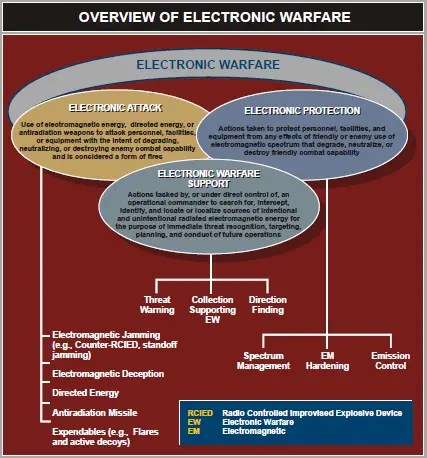
Activities used in EW include: electro-optical, infrared and radio frequency countermeasures; EM compatibility and deception; Radio jamming, Radar jamming and deception and Electronic counter-countermeasures (or anti-jamming); electronic masking, probing, reconnaissance, and intelligence; electronic security; EW reprogramming; emission control; spectrum management; and wartime reserve modes.[1][3]
Electronic Warfare Training Areas on the Olympic Peninsula:

Types of Electronic Warfare
Electronic warfare consists of three major subdivisions: Electronic Attack (EA), Electronic Protection (EP), and Electronic Warfare Support (ES).[1] Each of these is discussed below.
- Electronic Attack:
Electronic Attack (EA) involves the offensive use of EM energy, directed energy, or anti-radiation weapons to attack personnel, facilities, or equipment with the intent of degrading, neutralizing, or destroying enemy combat capability including human life. In the case of EM energy, this action is most commonly referred to as jamming and can be performed on communications systems or radar systems. In the case of anti-radiation weapons, many times this includes missiles or bombs that can home in on a specific signal (radio or radar) and follow that path directly to impact, thus destroying the system broadcasting.
An Electronic Warfare Tactics Range (EWTR) is a practice range which provides for the training of personnel in electronic warfare. There are two examples of such ranges in Europe; one at RAF Spadeadam in the northwest county of Cumbria, England and the Multinational Aircrew Electronic Warfare Tactics Facility Polygone range on the border between Germany and France. EWTRs are equipped with ground-based equipment to simulate electronic warfare threats that aircrew might encounter on missions. Other EW training and tactics ranges are available for ground and naval forces as well.
2. Electronic warfare support:
Electronic Warfare Support (ES) is a subdivision of EW involving actions taken by an operational commander or operator to detect, intercept, identify, locate, and/or localize sources of intended and unintended radiated electromagnetic (EM) energy. This is often referred to as simply reconnaissance, although today, more common terms are Intelligence, Surveillance and Reconnaissance (ISR) or Intelligence, Surveillance, Target Acquisition, and Reconnaissance (ISTAR). The purpose is to provide immediate recognition, prioritization, and targeting of threats to battlefield commanders.[1]
Signals Intelligence (SIGINT), a discipline overlapping with ES, is the related process of analyzing and identifying intercepted transmissions from sources such as radio communication, mobile phones, radar or microwave communication. SIGINT is broken into three categories: Electronic Intelligence (ELINT), Communications Intelligence (COMINT), and Foreign Instrumentation Signals Intelligence FISINT. Analysis parameters measured in signals of these categories can include frequency, bandwidth, modulation, and polarization.

3. Electronic Warfare Protection
Electronic Protection (EP) involves actions taken to protect friendly forces (personnel, facilities, and equipment) from any effects of friendly or enemy use of the electromagnetic spectrum that degrade, neutralize, or destroy friendly combat capability (EA). So, EP brings with it the ability to defeat EA. Not to confuse the issue, but “jamming” is not part of EP, it is the target of EP. Jamming is an EA capability (see above).
While defensive EA actions (jamming) and EP (defeating jamming) both protect personnel, facilities, capabilities, and equipment, EP protects from the effects of EA (friendly and/or adversary). Other examples of EP include spread spectrum technologies, use of restricted frequency lists, emissions control (EMCON), and low observability (stealth) technology.[1]
Here are some decibel comparisons so you can get an idea of how loud the Growlers are. Before looking at the chart you should know:
- A Growler is not just a normal military jet. Where it says “military Jet aircraft takeoff at 50 feet” as 130 decibels, the Growlers are much louder: as high as 140 decibels at a distance of 1200 feet.
- Notice that a thunderclap is not as loud as a Growler. Yet if you’ve ever been close to something when it was hit by lightning, you know how loud that is!
- Notice that some other loud sounds are damaging “with 8 hour exposure”. The Growlers often fly all day or all night in a tight pattern around north Whidbey.
| Noise Source | Decibel Level | comment |
| Commercial Jet take-off (at 25 meters) | 150 | Eardrum rupture |
| Aircraft carrier deck | 140 | |
| Military jet aircraft take-off from aircraft carrier with afterburner at 50 ft (130 dB). | 130 | |
| Thunderclap, chain saw. Oxygen torch (121 dB). | 120 | Painful. 32 times as loud as 70 dB. |
| Steel mill, auto horn at 1 meter. Turbo-fan aircraft at takeoff power at 200 ft (118 dB). Riveting machine (110 dB); live rock music (108 – 114 dB). | 110 | Average human pain threshold. 16 times as loud as 70 dB. |
| Jet take-off (at 305 meters), use of outboard motor, power lawn mower, motorcycle, farm tractor, jackhammer, garbage truck. Boeing 707 or DC-8 aircraft at one nautical mile (6080 ft) before landing (106 dB); jet flyover at 1000 feet (103 dB); Bell J-2A helicopter at 100 ft (100 dB). | 100 | 8 times as loud as 70 dB. Serious damage possible in 8 hr exposure |
| Boeing 737 or DC-9 aircraft at one nautical mile (6080 ft) before landing (97 dB); power mower (96 dB); motorcycle at 25 ft (90 dB). Newspaper press (97 dB). | 90 | 4 times as loud as 70 dB. Likely damage 8 hr exp |
| Garbage disposal, dishwasher, average factory, freight train (at 15 meters). Car wash at 20 ft (89 dB); propeller plane flyover at 1000 ft (88 dB); diesel truck 40 mph at 50 ft (84 dB); diesel train at 45 mph at 100 ft (83 dB). Food blender (88 dB); milling machine (85 dB); garbage disposal (80 dB). | 80 | 2 times as loud as 70 dB. Possible damage in 8 h exposure. |

 MANAGE THE DAMAGE