
JET EMISSIONS COMPARISON DOCUMENT: https://docs.google.com/spreadsheets/d/1wsLDJmTWqAHLkS9L5F3D-Y_Abx2lNNDkw4sjpmwpC2Y/edit?usp=sharing
Noise Zone map and article: https://disclosuredeception.wordpress.com/noise-zone-map/

Unsafe Growler Flight Paths

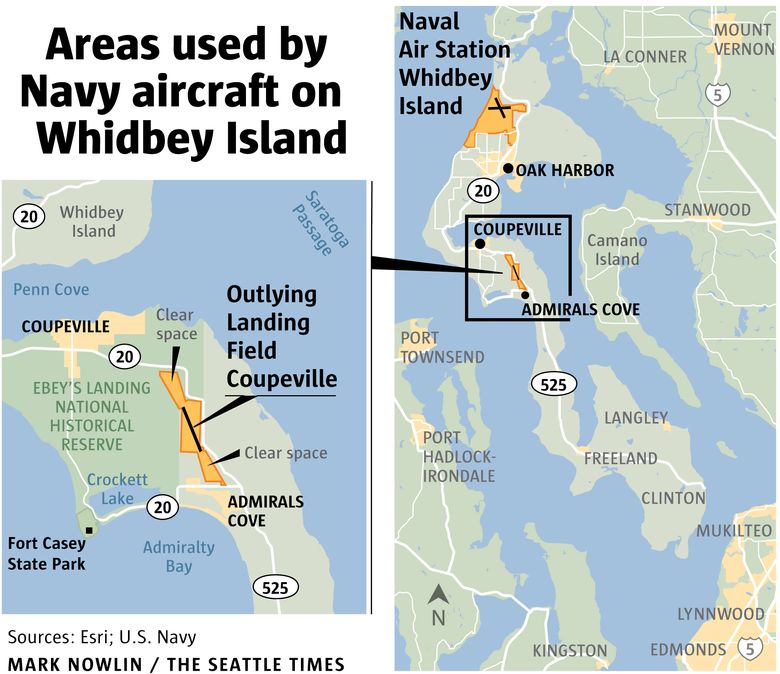
link to article: https://sites.evergreen.edu/basewatch/whidbey-island-noise-contour-apz-map-ari-johnson/
WHY IS EXCESSIVE NOISE A PROBLEM?
How Do Decibel Measurements Work?
A decibel (dB) is a measure of sound volume. Typically, those living in rural areas will experience an ambient noise level between 40 and 50 dB. In public places, about 70 dB is the usual ambient level of noise. At 80 dB, we begin to consider noise annoying unless we’re in a noisy nightclub (110dB). At 110 dB, OSHA says we can endure the noise up to 30 minutes before we begin to lose our hearing. At 160 dB we have only 7 minutes total per day before permanent hearing loss results.
Noise-induced hearing loss (NIHL) is permanent hearing impairment resulting from exposure to loud sound. People may have a loss of perception of a narrow range of frequencies, or impaired perception of sound, including hypersensitivity to sound or ringing in the ears.

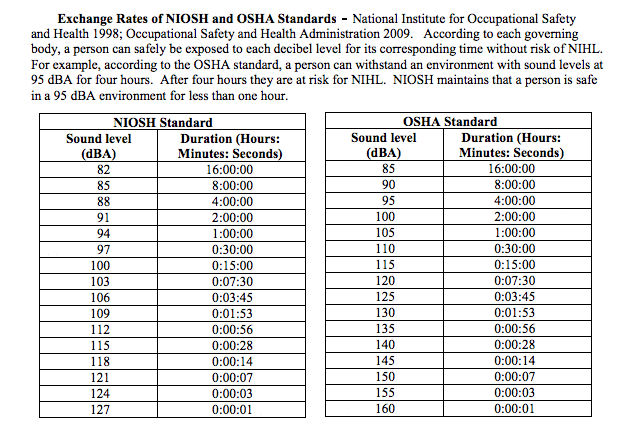
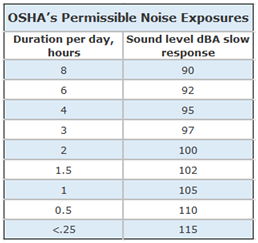
During Growler fly-overs, measurements taken on the ground below them typically exceed 120 dB. For those living under these flight paths, this happens every few minutes all day long and often into the night. This repeated excessive level of sound far exceeds the total time-per-dB exposure that is considered safe. In other words, people living under the jets are losing their hearing.
To better understand how dBs are measured, it’s important to know that, for instance, 120 dB DOESN’T mean “twice as loud as 60 dB.” Decibels are measured on a logarithmic (not linear) scale, so each increment of 10 dB represents 10 times the volume. Therefore, +10 dB = 10x louder. +20 dB = 100 times louder. +30 dB = 1,000 times louder. +40 dB = 10,000 times louder. +50 dB = 100,000 times louder. And +60 dB = 1,000,000 (that’s one million) times louder than ten decibels.
To get an idea of this scale, turn your speaker up to maximum volume, listen to this video which at a normal speaker volume is about 75 dB, and then consider that it is actually more than ten thousand times louder. https://www.youtube.com/watch?v=y3XMUBU6HLc
Above and below: Military Aircraft Noise in Air and under Water at Whidbey Island, Washington
by Lauren M. Kuehne 1,2,*,Christine Erbe 3,Erin Ashe 4,Laura T. Bogaard 4,Marena Salerno Collins 4 andRob Williams 41School of Aquatic and Fishery Sciences, University of Washington, 1122 NE Boat Street, Seattle, WA 98105, USA2Omfishient Consulting, 2333 Seringa Avenue, Bremerton, WA 98310, USA3Centre for Marine Science and Technology, Curtin University, GPO Box U1987, Perth, WA 6845, Australia4Oceans Initiative, 117 E Louisa St #135, Seattle, WA 98102, USA*Author to whom correspondence should be addressed.
The full article is here:
https://www.mdpi.com/2077-1312/8/11/923/htm
Local Politician Caught in Libel regarding home buyers in flight zones
See article here:
https://disclosuredeception.wordpress.com/petition-deception/
 MANAGE THE DAMAGE